
Page was created on 09/23/2026
Spark (which is sometimes stylized as SPARK in all caps, with the route abbreviation being SPK & its internal route number being 601) is PSTA’s second branded transit service & is what is known to some transit experts & advocates as BRT Lite. This means that Spark encompasses some BRT like qualities but does not utilize specialized bus lanes. While original plans for Spark did include the use of semi-dedicated lanes along its route – state-level political changes unfortunately caused that particular design element to be removed from the final project.
As its name suggests, Spark utilizes a dedicated sub-fleet of 40-foot battery electric powered Gillig Low Floor Plus buses. These buses look like the rest of PSTA’s battery electric Gillig fleet, but the buses used on Spark have the rear plug-style door option like the buses used on the SunRunner do. This allows customers to use either the front door or the rear door to board & alight, & contactless card readers are positioned at both doors to allow those paying with either Flamingo Fares or another contactless payment method to quickly pay & board. Unlike the SunRunner, Spark does allow for cash payment, but those paying with cash will need to board the bus using the front door.
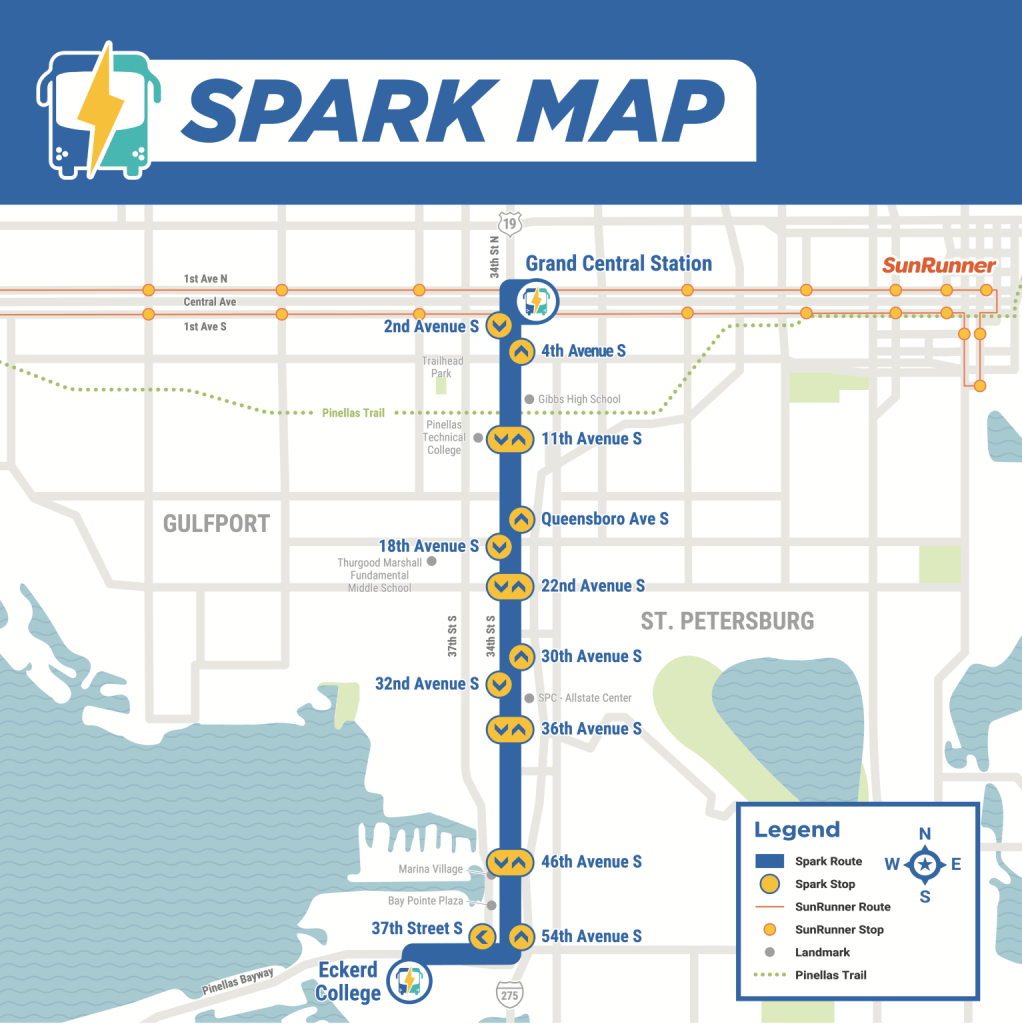
The average one-way travel time on Spark from Eckerd College to Grand Central Station is 15 minutes.
Service Amenties
Customers can find the following amenities while using Spark.
- Streamlined, contactless fare payment: For customers wishing to pay using Flamingo Fares or another contactless payment method, there’s no need to wait at the front door. Customers may enter through the rear door after alighting customers have exited the bus & use the rear fare validator to pay their fare.
- Easy entry & exit: Because Spark also utilizes all door boarding, customers can get on & off with ease – even if a cash-paying customer is at the front of the bus. If using a mobility device, signal to the operator that you wish to have the wheelchair ramp lowered & enter through the front door.
- Stylized stations: While Spark stations are somewhat different than SunRunner stations, they also feature uniquely designed station shelters & placemark totems equipped with route maps for easy wayfinding.
- Wi-Fi & USB charging ports: As with the rest of the PSTA system, Wi-Fi access are available on all Spark buses. Buses are also equipped with USB charging ports.
Differences Between Services
If you’ve had the opportunity to ride both Spark & SunRunner, then you’ll notice some key differences between the routes. Below is a table describing these differences. For comparison purposes, I’ve also listed the Jacksonville Transportation Authority (JTA) First Coast Flyer BRT Lite system – as it possesses similarities to Spark as well.
| PSTA SunRunner | PSTA Spark | JTA First Coast Flyer | |
| Route Network | Single Route | Single Route | Multi Route (4 routes total) |
| Overall Span of Service (Operating Hours) | 7-Days-A-Week 5am hour until 12-midnight | 7-Days-A-Week 5am hour until 12-midnight | 7-Days-A-Week 4am hour until 12-midnight |
| Route Frequency | 5am hour: Every 30 minutes (all days) 6am through 8pm (Sunday through Thursday): Every 15 minutes 8pm through 12-midnight (Sunday through Thursday): Every 30 minutes 8pm through 12-midnight (Friday & Saturday): Every 15 minutes | 5am hour: Every 30 minutes (all days) 6am through 8pm (Sunday through Thursday): Every 15 minutes 8pm through 12-midnight (Sunday through Thursday): Every 30 minutes 8pm through 12-midnight (Friday & Saturday): Every 15 minutes | 4am through 6pm (all days): Every 20 minutes 6pm through 12-midnight (all days): Every 30 minutes |
| Semi-dedicated Lanes | Yes (along 1st Avenues) | No | No (some areas do have bus pull-out bays & queue jumps) |
| Level Boarding | Yes (except for the stop at the St. Pete Beach Access) | No | No |
| Fare Payment Options | Contactless only | Cash & contactless | Cash & contactless |
| Branded Shelters | Yes | Yes | Yes |
| Branded Buses | Yes (buses have the rear plug-style door option) | No (buses have the rear plug-style door option) | Yes (buses have standard rear doors) |
| Bike Rack Setup | 3 interior racks (near rear door) | 2 exterior racks (front of bus) | 2 exterior racks (front of bus) |
| Transit Signal Priority (TSP) Usage | Yes | Not Yet Set Up (planned for 2027) | Yes |
With Transit Signal Priority, the system typically activates when traffic conditions begin to cause buses to fall more than 15 minutes behind schedule. However, this is not really advertised & there is heavy speculation that the Florida Department of Transportation (FDOT) is heavily regulating use of TSP protocols to prioritize traffic on Interstate 275 & other limited access highways throughout the state of Florida.
Across all three services, buses stop at all stations, regardless of whether customers are boarding/alighting or not to create a premium, train-like experience.
Note: I don’t list the Hillsborough Transit Authority MetroRapid service in the table above. This is because well…the MetroRapid service name has basically vanished from existence. Read my blog post on The Rise & Fall of HART MetroRapid.
Fleet
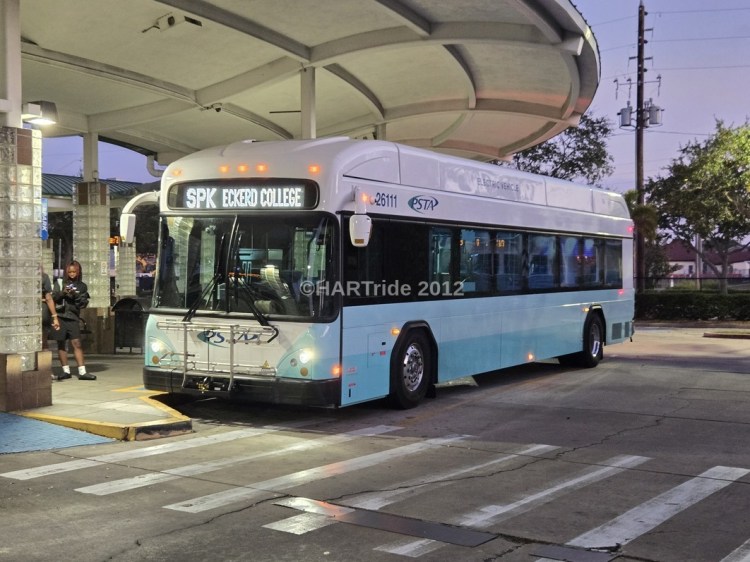
Spark uses a dedicated sub-fleet of seven 2026-model 40-foot Gillig Low Floor Plus buses. While they are painted in the same white/two-toned aqua livery scheme as most of PSTA’s other buses, the distinguishing feature is the use of the plug-style rear door option that is used on the SunRunner. During any given time of the day, up to three buses are used on the Spark route.

