
Page was last updated on 01/08/2025.

How did we get here?
While planning for what is today known as the SunRunner began in 2015, preliminary plans for some form of premium transit option go as far back as 2009. Launching a premium transit option in the Tampa Bay region has always been elusive due to funding constraints, mixed public support, & numerous failed attempts to pass voter initiatives for a dedicated sales tax.
Greenlight Pinellas
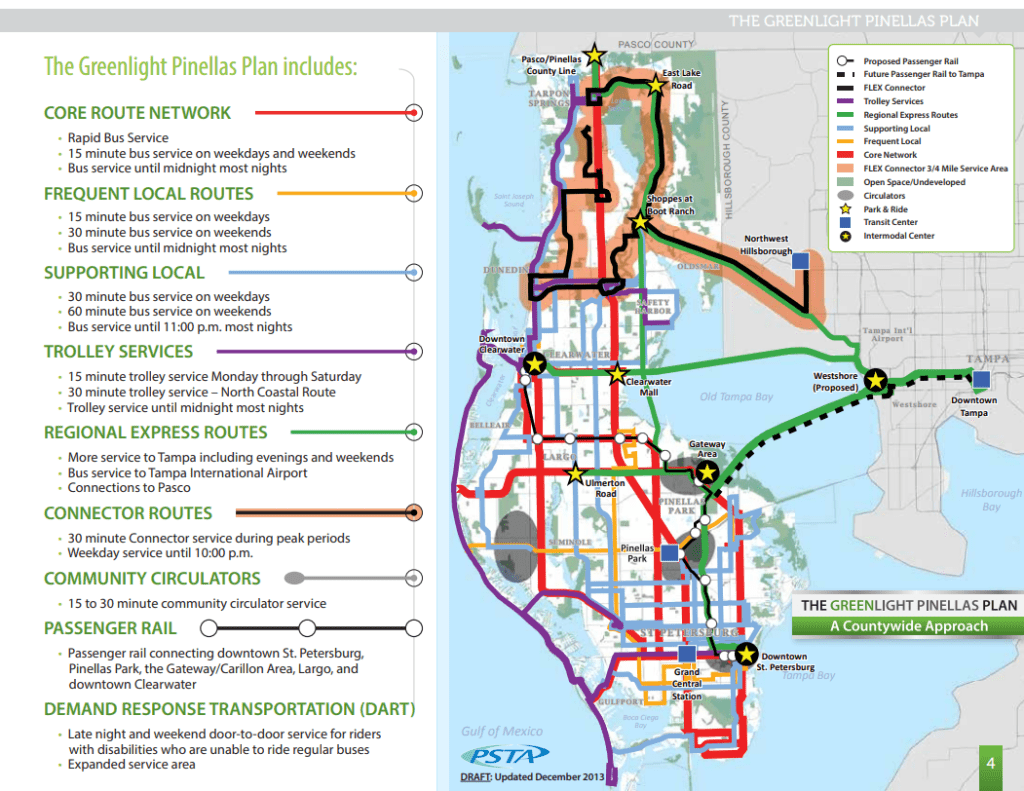
The most recent attempt for a dedicated sales tax was the Greenlight Pinellas plan. Had the voter initiative passed in the fall of 2014, it would have allowed PSTA & Pinellas County to enact transformational improvements & expansion to the entire bus network, as well as utilize CSX freight right-of-way for a north-south light rail line. Several rapid bus routes were proposed under the plan – which would allow for eventual transitioning to a Gold Standard Bus Rapid Transit (BRT) service on select corridors. These corridors include:
- 1st Avenues from Downtown St. Petersburg to South Pasadena, then across the Corey Causeway into St. Pete Beach – the very corridor that the SunRunner follows today.
- 4th St from Pinellas Point to the Gateway region.
- 49th St from Central Ave to Roosevelt Blvd.
- The East Bay Dr corridor in Largo.
- The Ulmerton Rd corridor in Largo & Gateway.
- The US Hwy 19 Corridor.
- A line that would utilize 58th St N near Pasadena between Central Ave & 5th Ave N, then trek along 5th Ave N to Tyrone Blvd before travelling up Tyrone Blvd to the interchange with Seminole Blvd in Seminole. From there, service would utilize Seminole Blvd until it turns into Missouri Ave in Clearwater.
Evaluating BRT options
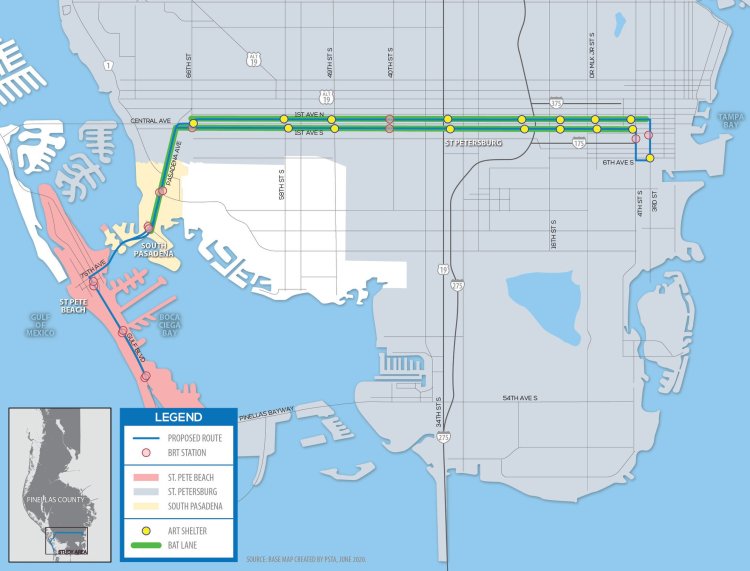
Following the failure of the Greenlight Pinellas initiative, county leaders have been hesitant to bring up another attempt – especially following several failed attempts in neighboring Hillsborough County. Therefore, the focus has since largely shifted towards implementing at least Bronze level BRT corridors throughout the county, focusing on the previously identified corridors mentioned above.
By 2017, it was increasingly becoming clear that the 1st Avenues/St. Pete Beach corridor would ultimately be selected as the first BRT project to initiate, as 1st Ave N & S have generally been wide 3 to 4-lane one-way streets that only saw modest traffic counts. Both streets would be able to be modified to handle dedicated or at least semi-dedicated bus lanes & island station platforms. Improvements to sidewalks & bike lane infrastructure could be integrated into the larger project. Additionally, the corridor provided the most ridership potential being that it would be able to seamlessly link Downtown St. Pete to St. Pete Beach.
Construction begins
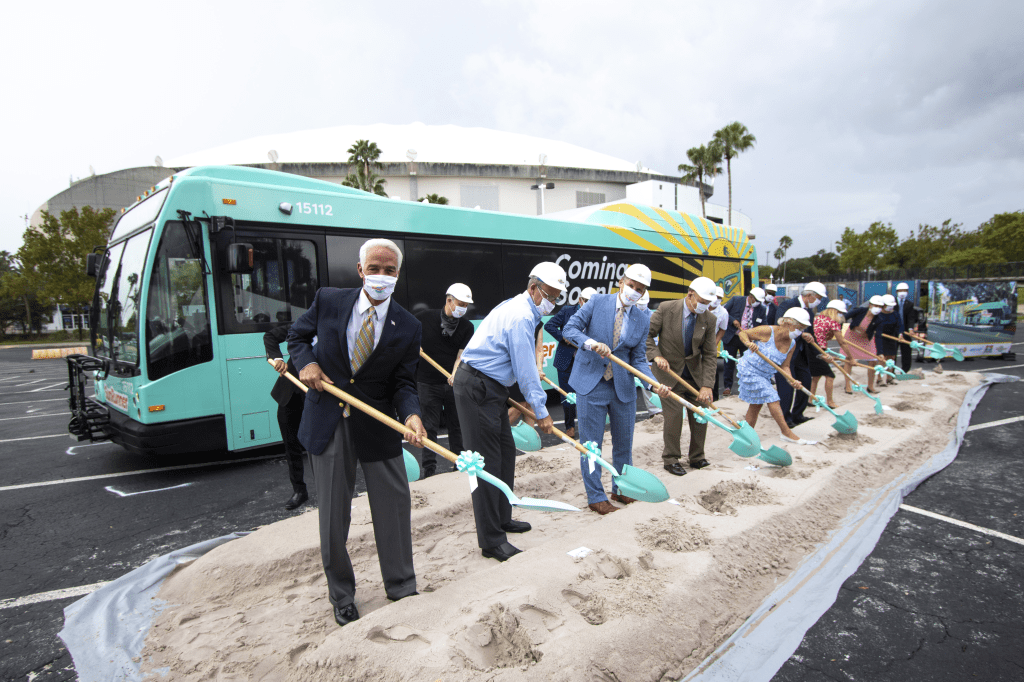
While construction of the SunRunner was originally envisioned to get underway in 2018, several delays in the planning process caused a pushback into 2020 – during the height of the Coronavirus pandemic. During that year however, federal funding commitments were secured, the SunRunner name was formally unveiled to the public, & the project was able to gain tremendous support from residents, business owners, government officials, & other key partners.
Despite both Covid & non-Covid-related delays in the overall project, construction of the SunRunner stations, modification of existing roadways, & other elements were able to be carried out without any substantial increases in budget. In fact, the SunRunner was able to be completed with some allowance left in the federal funding allocation – which allowed PSTA to secure three additional buses for the route & begin planning for an additional station.
Formal Launch

The SunRunner opened to immense fanfare on October 21, 2022 & carried over 60,000 riders during its first several months in service. The line has been able to introduce those to the PSTA system who otherwise would not have considered using public transit at all – including those who seek an alternative to dealing with parking & traffic woes while going to the beach. The overall popularity with the SunRunner, even as fare collection began nearly a year after its launch, will no doubt spark the desires to further expand the network to other busy corridors – such as Seminole Blvd.
Additional Station & Buses
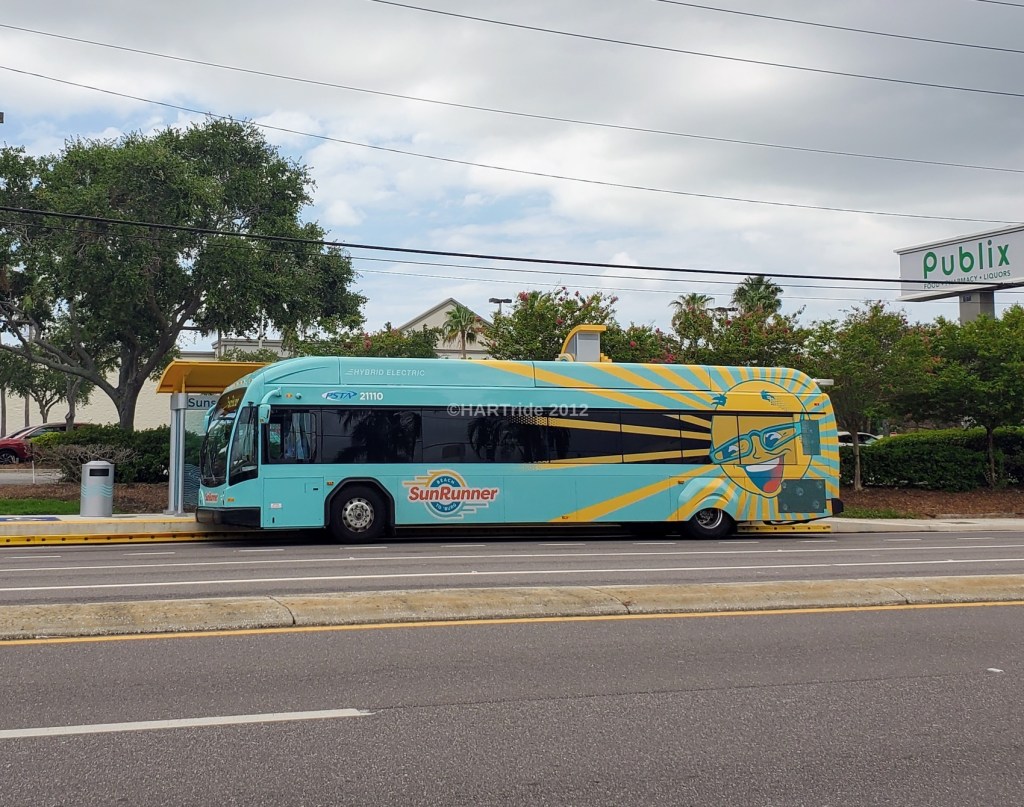
Because the initial project was completed below budget, the extra federal funds were used to construct a new station on 1st Ave N, next to the Ascent St. Petersburg apartment tower & the Sundial parking garage. Construction of the station began in August, 2024 & is slated to become operational in time for the February, 2025 service changes. The remaining additional funds were also used to purchase three 2024 model 40′ Gillig BRT Plus Hybrid buses – equipped with near-identical specifications to the initial nine buses – to help maintain a healthy spare bus ratio & to prepare for service to the additional station. These buses were delivered to PSTA during the spring of 2024 & were in revenue service beginning in May of that year.
 The Global Transit Guidebook